
Aston Martin DB5 - The Secret Agent Icon

A Royal Birth: History and Design
Aston Martin unveiled the DB5 in 1963 as the successor to the DB4. Its name pays tribute to David Brown, the company's owner at the time, under whose leadership Aston Martin enjoyed its golden age.
Designed and built in Newport Pagnell, UK, the DB5 carried over the DB4's stunning silhouette (the work of Italian coachbuilder Touring Superleggera) while adding significant technical improvements. In its day, it was the quintessential British GT (Grand Tourer): fast, comfortable and incredibly refined.
Technical Specifications: The Heart of the Beast
Beneath its sculpted body, the DB5 concealed an engine and equipment worthy of its status:
-
Engine: An all-aluminum 4.0-liter inline six.
-
Power: In standard form, it produced around 282 horsepower (hp).
-
Top Speed: It could reach nearly 230 km/h (143 mph), a feat for the time.
-
Transmission: It was typically fitted with a five-speed manual transmission from ZF.
-
Construction: Its body was built using Touring's famous Superleggera (super light) method, with thin steel tubes covered by aluminum panels.
Although it was not the most powerful car of its time, the DB5 offered an exceptional balance of luxury and performance, making it a true gentleman's car.
Cultural Influence: James Bond's Secret Weapon
The Aston Martin DB5's fate changed in 1964 with the release of the film "Goldfinger". The director chose the DB5 as the car of British secret agent James Bond (007), played by Sean Connery.
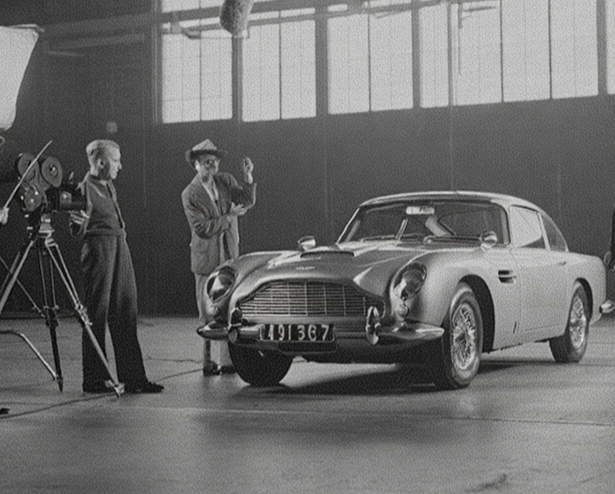
This partnership was one of the most successful product placements in film history and elevated the DB5 to the status of ultimate automotive legend.
In Goldfinger, the car was not just a means of transportation; it was an extension of the spy's arsenal, equipped with memorable gadgets designed by the expert Q:
-
Revolving license plates.
-
Passenger ejector seat.
-
Machine guns concealed behind the headlights.
-
Rear oil slick sprayer.
The DB5 made notable appearances in six other films in the series (including Thunderball, GoldenEye, Casino Royale and, more recently, No Time to Die), securing its place in the public imagination as the James Bond car and overshadowing even more modern models.
A Timeless Legacy
The original DB5 production run was short, ending in 1965 with only 1,021 cars built. However, its influence endures.
Today, it is one of the most expensive and sought-after collector cars in the world. Aston Martin itself continues to honor its legacy: between 2020 and 2021, the brand launched a limited series of DB5 Goldfinger Continuation cars, some of them fitted with working replicas of Q's gadgets (not for road use, of course!).
The Aston Martin DB5 is not just a beautiful piece of 1960s engineering; it is a monument of film history and an enduring symbol of British-style luxury and adventure.
Share this content