
Peugeot 406 "Taxi": The Unexpected Heroine of French Cinema

The Peugeot 406 Taxi, an icon of French and international pop culture thanks to its spectacular transformation in the "Taxi" saga. It proved that a family sedan could be the fastest star in Marseille.
An Everyday Car: History and Design
The Peugeot 406 was launched in 1995 and was intended for a far more modest role than the one cinema gave it. Designed to replace the 405, it was the quintessential family sedan, praised for its comfort, its exemplary handling and its elegant, understated design, typical of the French school of the 1990s.
It was the archetype of the reliable, practical car, far removed from Formula 1 circuits. It is precisely this humble base that made its on-screen metamorphosis so impressive and memorable.
Technical Specifications: The French Base
In standard form, the 406 offered a range of conventional engines. However, the cars used by the Marseille taxi driver were often based on the most powerful versions available.
-
Engine (Standard Range): The 406 was fitted with a variety of engines, ranging from the 1.8 L to the powerful 3.0-liter V6 (the top-of-the-range version) or the reliable 2.0-liter Turbo (the version potentially used as the base for the modifications).
-
Power (Fastest Base): The 3.0 L V6 could reach around 194 hp.
-
Handling: Even in stock form, the 406 was praised by the motoring press for its exceptional chassis and uncompromising comfort, a major asset for stability at speed.
The Movie Version: In the fiction, the 406 is transformed into a racing beast capable of rivaling Ferraris. It was given turbos, extreme body kits, hydraulic systems for instant wheel changes, and power well above 300 hp.
Cultural Influence: The Embodiment of "Made in France" Speed
The 406's destiny changed in 1998 with the first "Taxi" movie, produced and written by Luc Besson.
The hero, Daniel Morales (Samy Naceri), a speed-obsessed taxi driver, transforms his standard yellow sedan into a stealthy racing machine. This central element of the movie had several major impacts:
-
The Symbol of French Tuning: The movie popularized the concept of "tuning" and automotive performance with the general public in France, showing that with clever modifications, even a production car could become formidable.
-
The Automotive Anti-Hero: Unlike James Bond and his exotic Aston Martin, the 406 was a car you could see on the street every day. Its success created a special affection for this French car, seen as the "people's" heroine capable of outpacing German and Italian supercars.
-
Technical Evolution on Screen: In the sequels (Taxi 2 and Taxi 3), the 406 continued to evolve, showing off even crazier transformations (retractable wings, snow skis) and cementing its status as a French-style "gadget" car.
The Peugeot 406 is more than a movie prop; it is proof that automotive legend does not depend on the purchase price, but on the passion and imagination invested in it. It remains the ultimate reference for the French sports sedan on the big screen.
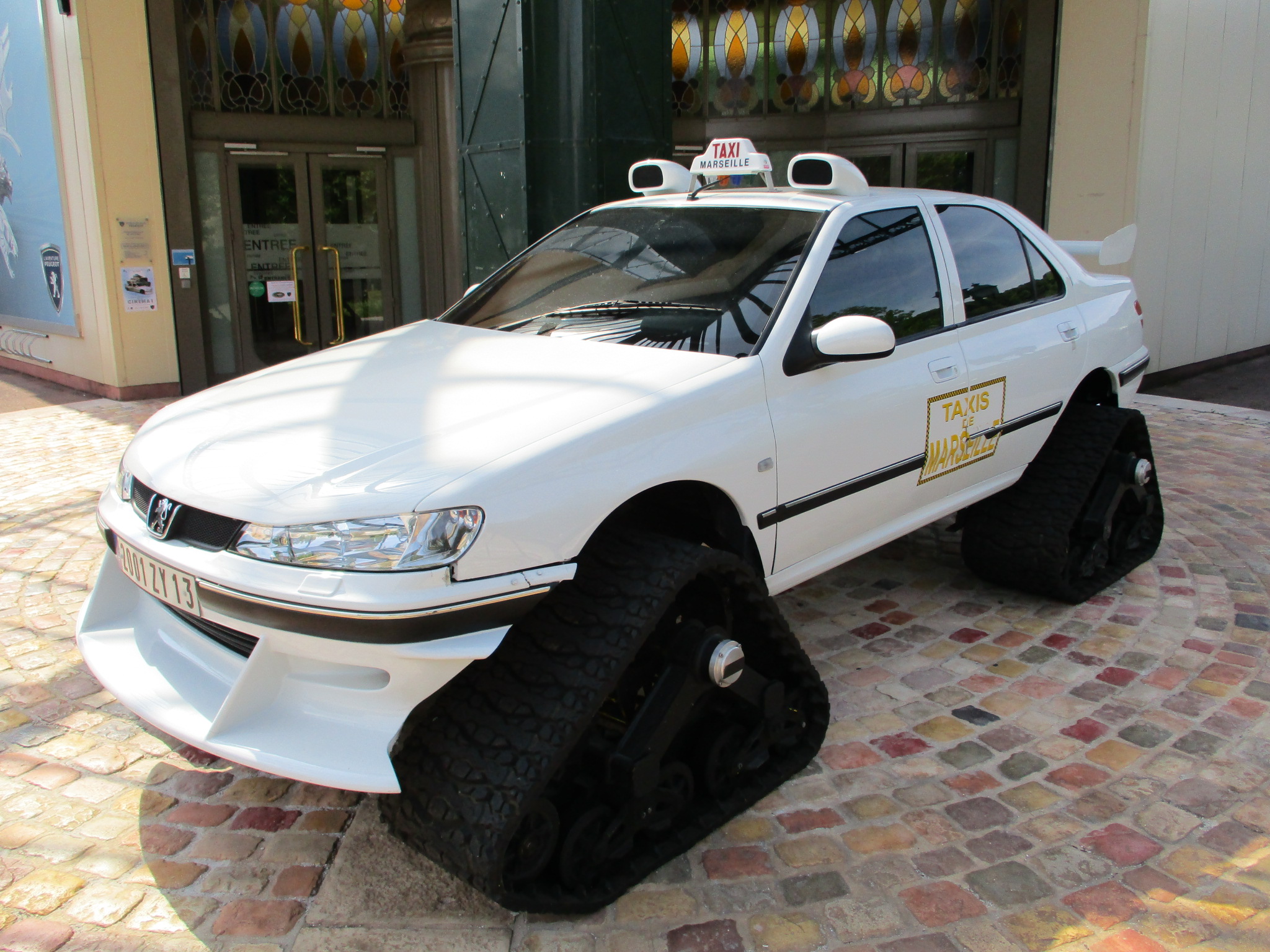
"Geeeneral aleeeert!"
Credits:
By Arnaud 25 - Own work, CC BY-SA 4.0, https://commons.wikimedia.org/w/index.php?curid=61974396
By René Cortin - Own work, CC BY-SA 4.0, https://commons.wikimedia.org/w/index.php?curid=130562094
Share this content