
Nissan Skyline GT-R R34: The Icon of JDM and Pop Culture

If one car sums up the glory of 1990s Japanese performance engineering, it is the Nissan Skyline GT-R R34. The last model to bear the legendary "Skyline" name, this car is revered for its aggressive looks, its technological performance and, above all, for the aura it gained in video games and movies. It is the very embodiment of JDM (Japanese Domestic Market).
The Peak of the Skyline Era: History and Design
The GT-R R34 was launched in 1999, succeeding the legendary R32 and R33. Nissan's mission was to further refine an already successful formula, focusing on better handling and more radical styling, notably by reducing the perceived length compared to the R33.
Designed as a true homologation machine for racing (notably in Super GT), the R34 benefited from all the expertise Nissan had built up. It featured an instantly recognizable angular, muscular design, with its famous massive rear wing and its iconic twin round taillights.
Technical Specifications: The "RB26DETT" and ATTESA
The heart and soul of the R34 lie in its engine, the legendary RB26DETT. This engine is the reason the R34 is still considered one of the best tuning platforms in the world.
-
Engine: 2.6-liter twin-turbo inline six (engine code RB26DETT).
-
Official output: Officially, it produced 280 hp, due to the "gentlemen's agreement" that capped the power of Japanese cars at the time.
-
Actual output: It was common knowledge that the engine produced slightly more straight from the factory and, above all, that it could easily handle more than 500 hp with basic modifications.
-
Drivetrain: It used a six-speed Getrag manual transmission and Nissan's ATTESA E-TS Pro all-wheel-drive system, which could send torque to the front wheels only when needed, allowing the car to stay agile and retain a rear-wheel-drive (RWD) feel until the power became too great.
Thanks to this balance of power, all-wheel drive and a stiff chassis, the R34 was an extremely capable car, delivering impressive feats on track despite its rated output.
Cultural Influence: The Blue Star
The GT-R R34 would never have reached such legendary status without its central role in media culture:
-
The JDM icon: It became the face of the JDM movement and of performance tuning. Its "legend" reputation was built on its ability to be modified to the extreme, attracting a legion of fans who revere its almost limitless performance potential.
-
Fast & Furious: Just like the Supra Mk IV, the R34 skyrocketed in popularity thanks to the franchise, notably "2 Fast 2 Furious" (2003). The Bayside Blue GT-R R34 driven by Paul Walker (Brian O'Conner) is one of the most recognizable cars in action movie history.
-
Video games: It is inseparable from racing video games such as Gran Turismo and Need for Speed, where it is often the players' preferred choice for its performance and customization potential.
Production of the R34 ended in 2002, but its reputation keeps growing. Today, as a highly collectible model, particularly in the United States since the 25-year import rule took effect, it sells for astronomical prices. The Nissan GT-R R34 remains a symbol of the last analog, high-performance era of Japanese engineering.
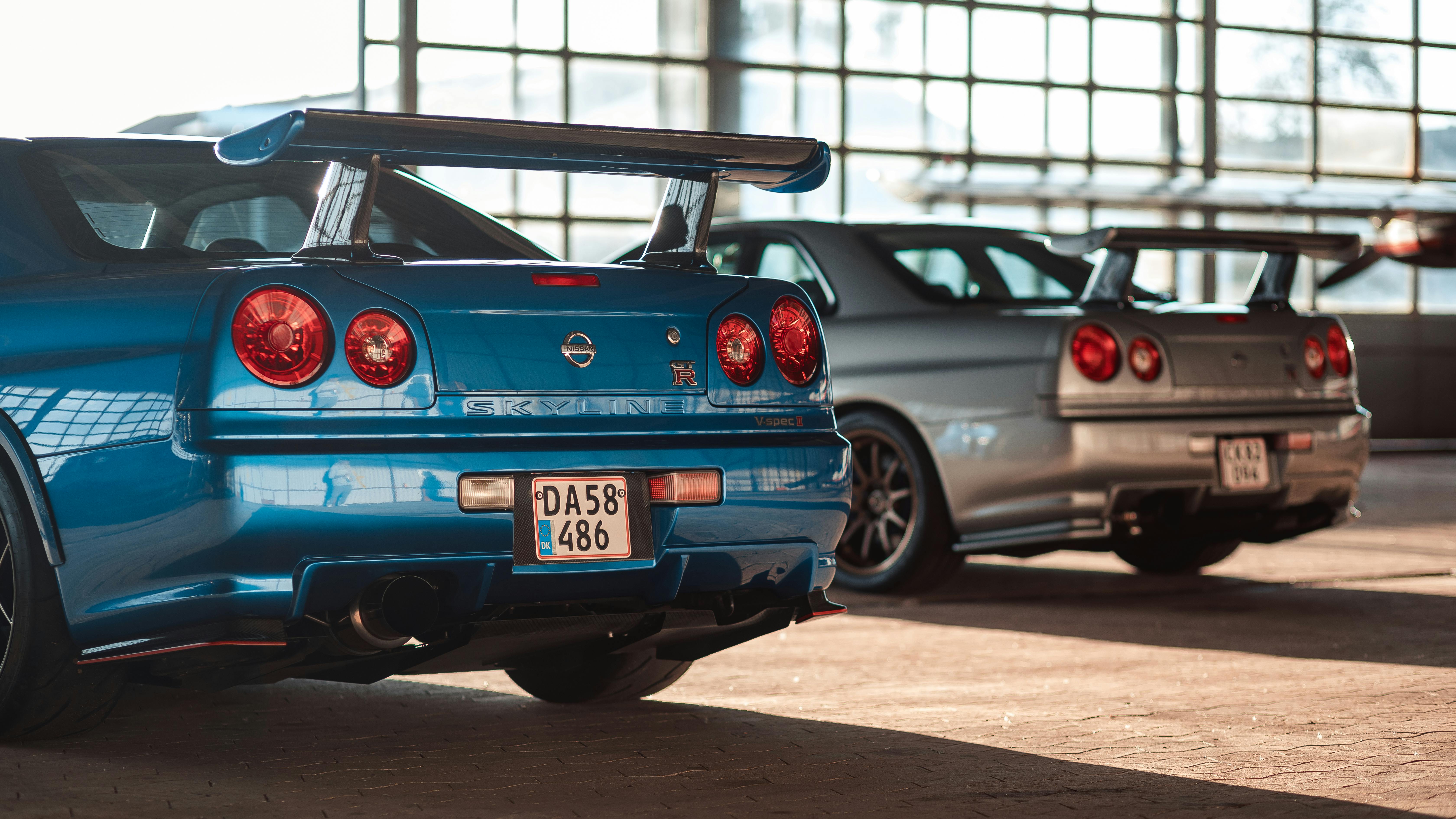
Photo by Federico Abis: https://www.pexels.com/fr-fr/photo/nissan-skyline-r34-gtr-dans-les-rues-de-tokyo-30968124/
Photo by Sebastian Pichard: https://www.pexels.com/fr-fr/photo/deux-nissan-skyline-r34-gt-r-dans-un-hangar-d-avion-au-coucher-du-soleil-12608881/
Share this content